Welcome to JARAWALA | 110+ Years old firm since 1914 | The First Choice of Indian Namkeen and Sweet Makers.
Welcome to JARAWALA | 110+ Years old firm since 1914 | The First Choice of Indian Namkeen and Sweet Makers.
A comprehensive engineering guide for snack food processors, industrial halwais, and farsan manufacturing units to select the exact outer diameter (OD), shaft bore, keyway, and CNC hole gauge for automatic and manual extruders.
In high-capacity commercial snack production, your namkeen extruder disc (jali) is the single critical orifice governing flow velocity, shear rate, dough temperature, and motor amperage. Selecting an improperly sized disc creates severe manufacturing bottlenecks:
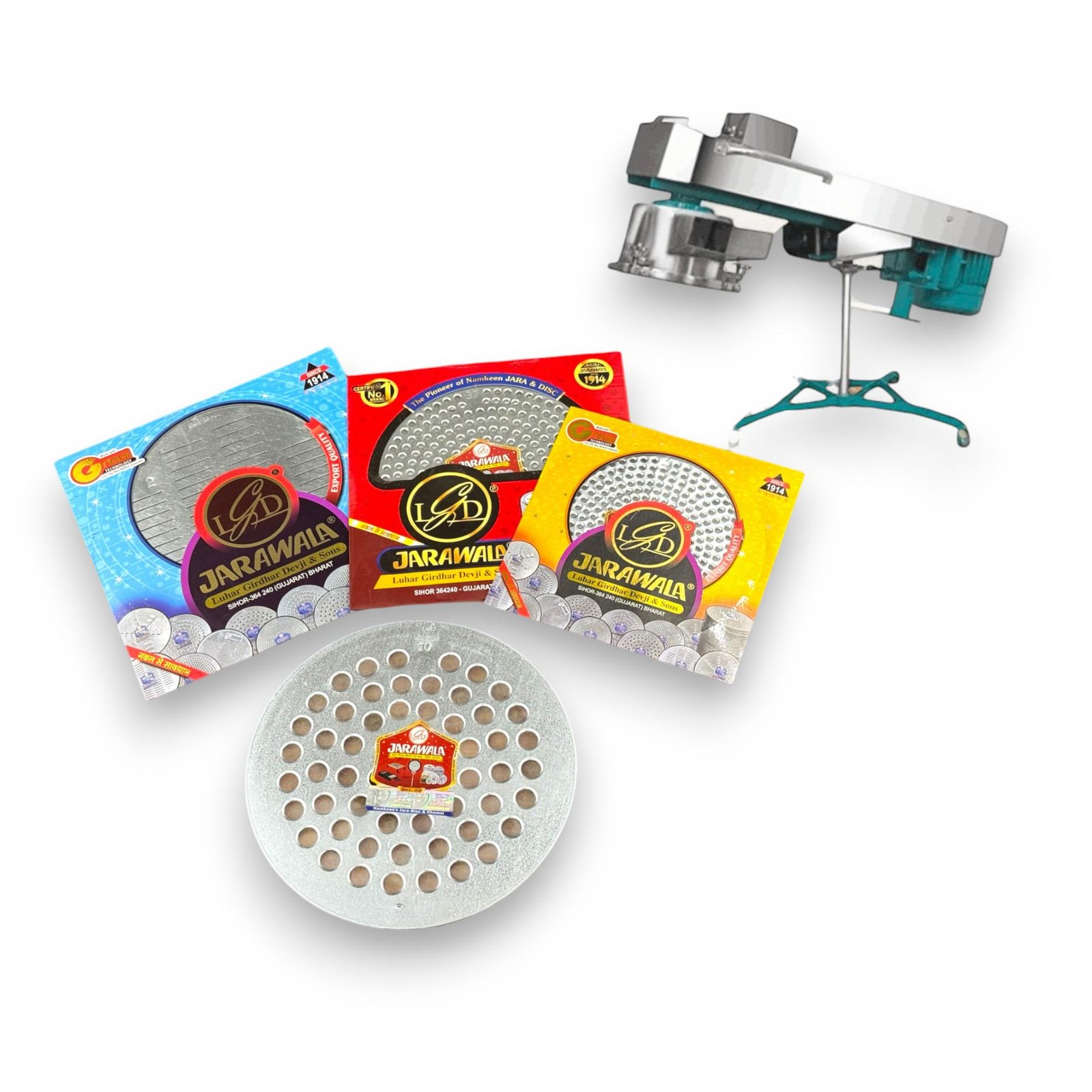
Commercial namkeen extruders manufactured across India (Rajkot, Ahmedabad, Indore, Coimbatore, and Delhi) adhere to standardized disc sizing envelopes. Below is the master fitment matrix engineered and supplied by Jarawala:
Tolerances: ±0.05mm
| Outer Diameter (OD) | Center Bore ID | Standard Keyway | Disc Thickness | Machine Types |
|---|---|---|---|---|
| 5.0″ (127 mm) | 19 mm / 22 mm | 5 mm × 2.5 mm | 4.0 mm – 5.0 mm | Semi-Automatic & Tabletop Extruders |
| 6.0″ (152 mm) | 22 mm / 25.4 mm (1″) | 6 mm × 3.0 mm | 4.5 mm – 6.0 mm | Standard Commercial Rotary Machines (40–80 kg/hr) |
| 7.0″ (178 mm) | 25.4 mm / 28 mm | 8 mm × 3.5 mm | 5.0 mm – 6.5 mm | Heavy-Duty Continuous Extruders (80–140 kg/hr) |
| 8.0″ (203 mm) | 28 mm / 32 mm | 8 mm × 4.0 mm | 6.0 mm – 8.0 mm | Industrial High-Capacity Hydraulic Extruders (120–200 kg/hr) |
| 9.0″ & 10.0″ (Custom) | 32 mm – 42 mm | 10 mm × 4.5 mm | 8.0 mm – 10.0 mm | Tier-1 Automated Continuous Processing Lines |
Different namkeen formulations—from ultra-fine nylon sev to thick, airy bhavnagari ganthiya—require exact perforation geometry to ensure smooth dough passage and optimal oil absorption during deep frying:
Material: SS 304 Food Grade
| Snack Variety | Hole Geometry | Exact Dimensions | Dough Viscosity | Ideal Frying Kadai Temp |
|---|---|---|---|---|
| Nylon Sev / Barik Sev | Round Micro-Punch | 0.8 mm – 1.0 mm | Medium-Soft (Pourable) | 175°C – 180°C (Instant 15s flash fry) |
| Ratlami Sev / Bhujia | Clover / Round Slit | 2.0 mm – 2.5 mm | Firm Spiced Besan | 170°C – 175°C |
| Bhavnagari Ganthiya | Oblong / Fluted Slit | 3.5 mm – 5.0 mm | Soft, Aerated Oil-Emulsified | 160°C – 165°C (Gentle puffing) |
| Papdi Ganthiya | Flat Ribbon Slit | 8.0 mm × 1.2 mm | Elastic Soda-Bi-Carb Dough | 165°C – 170°C |
| Murukku & Chakli | Star / Fluted Star (3 & 4 Point) | 3.0 mm – 4.0 mm | Rice & Urad Flour Stiff Dough | 165°C – 170°C |
| Boondi (Sweet / Salted) | Hemispherical Punch | 1.8 mm – 3.0 mm | Free-Flowing Liquid Batter | 180°C – 185°C |
When measuring your old disc for replacement, always measure using a digital vernier caliper across two perpendicular diameters to check for ovality. For the center bore, measure from the inside walls excluding the keyway cut-out. If your machine model lacks markings, our engineering team can match your fitment from a single high-resolution photograph and three caliper readings.
No account yet?
Create an Account