Namkeen Machinery & Production

Stainless Steel (SS 304) vs. Brass Extruder Dies: Commercial Production & Heat Longevity Guide

Metallurgy & Engineering • Luhar Girdher Devji & Sons (Est. 1914, Sihor)

Stainless Steel (SS 304) vs. Brass Extruder Dies: Commercial Production & Heat Longevity Guide

A rigorous metallurgical comparison for snack manufacturing plants, namkeen factory managers, and commercial food engineering procurement teams to optimize die wear life, dough friction, and FSSAI compliance.

1. The Metallurgy of Namkeen Extrusion

In continuous commercial snack processing, the extruder disc (jali) endures relentless abrasive friction from fiber-rich gram flour (besan), salt crystals, spices, and dough binders under hydraulic pressures exceeding 120 to 180 bar. Choosing between Austenitic Stainless Steel (SS 304) and High-Tensile Brass (CW614N / IS 319) significantly affects production uptime, sanitation schedules, and cost-per-kilogram extruded.

2. Head-to-Head Engineering Comparison Matrix

Metallurgical Scorecard • SS 304 vs. High-Tensile Brass

Industrial Benchmark

Engineering PropertyFood-Grade SS 304High-Tensile Brass (IS 319)Winner / Recommendation
Tensile Strength (MPa)515 – 620 MPa (Extreme rigidity)380 – 450 MPaSS 304: Superior resistance to bowing under 150+ bar hydraulic pressure.
Abrasive Wear Lifespan3,500 – 5,000+ Running Hours1,800 – 2,400 Running HoursSS 304: Extends die replacement interval by over 100%.
Surface Friction Coefficient0.28 – 0.32 (CNC electropolished)0.20 – 0.24 (Naturally self-lubricating)Brass: Smoother dough flow on aerated, low-moisture ganthiya doughs.
Corrosion & Salt ResistanceZero oxidation; immune to vinegar, citric acid & high saltSusceptible to surface verdigris if exposed to acids/moistureSS 304: Undisputed gold standard for shelf stability and FSSAI audits.
Thermal Conductivity16.2 W/m·K (Slow heat transfer)115 W/m·K (Rapid heat dissipation)Brass: Dissipates hydraulic frictional heat faster, keeping dough cooler.
CIP & Caustic Cleanability100% compatible with hot caustic soda (NaOH) washesTarnishes heavily; requires gentle manual detergent cleaningSS 304: Essential for automated Clean-In-Place (CIP) factory lines.

3. Application Guide: When to Choose SS 304 vs. Brass

A. When to Choose Food-Grade Stainless Steel (SS 304)

  • Automated Continuous High-Volume Lines: If your plant extrudes over 80 kg to 250 kg per hour with hydraulic or pneumatic rams.
  • High-Salt & Acidic Formulations: When extruding chatpata sev, tomato-chilli bhujia, or products formulated with citric acid, dry mango powder (amchur), or high salt percentages.
  • Export & Tier-1 Quality Certifications: SS 304 is mandatory for USFDA, BRCGS, ISO 22000, and corporate FSSAI compliance where copper-leaching risks are strictly prohibited.

B. When to Choose High-Tensile Brass

  • Traditional Bhavnagari & Papdi Ganthiya: Brass’s natural self-lubricating low friction allows soft, highly aerated oil-emulsified doughs to glide through ribbon and oblong orifices without tearing.
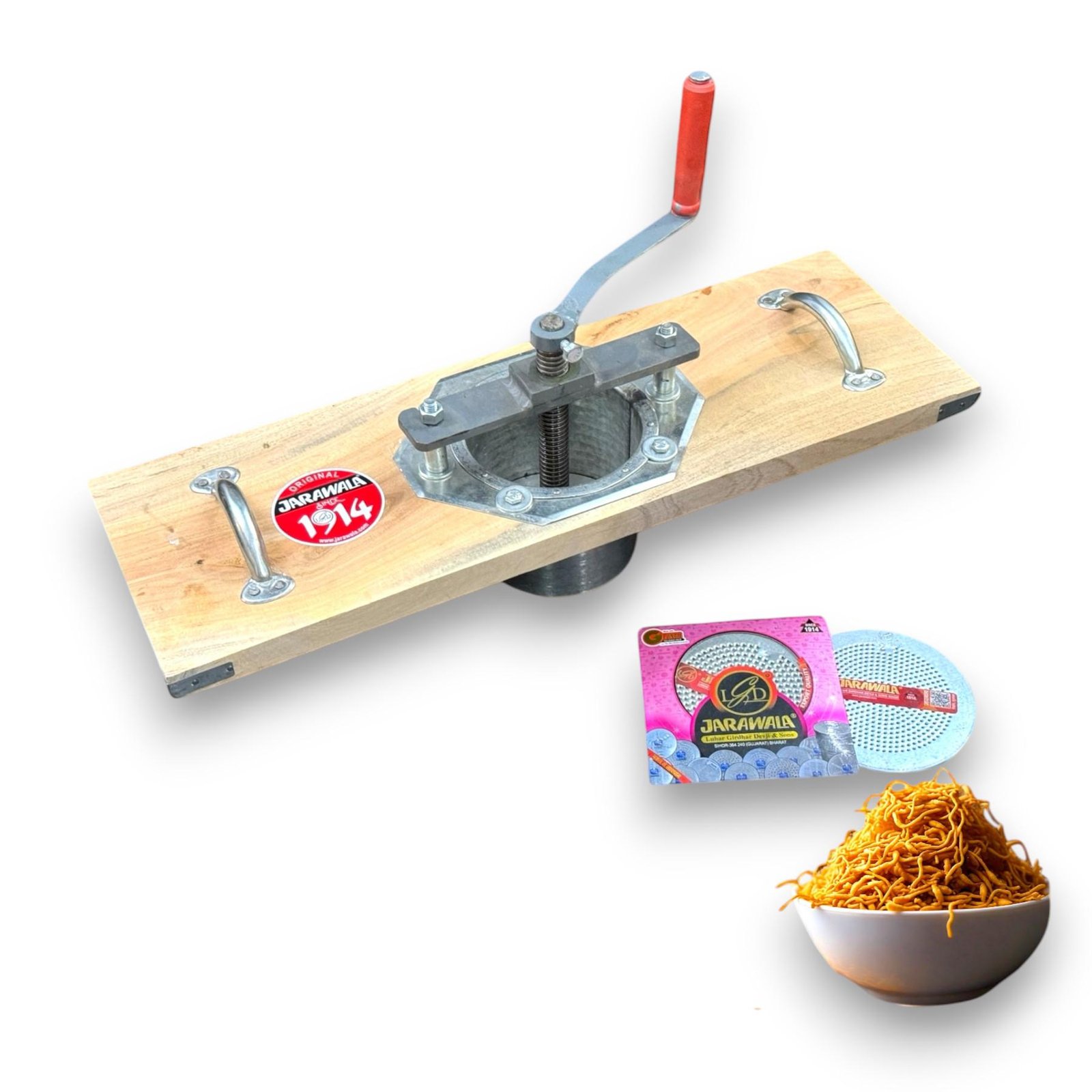
  • Manual Hand-Operated Sev Sanchas: The lower coefficient of friction substantially reduces operator arm fatigue during continuous manual pressing (see Manual vs. Electric Extruder Comparison).
  • Murukku & Chakli Forming: Rice flour doughs release with crisp, sharp edges when pressed through CNC brass star dies.

Jarawala Proprietary CNC Laser Piercing Technology

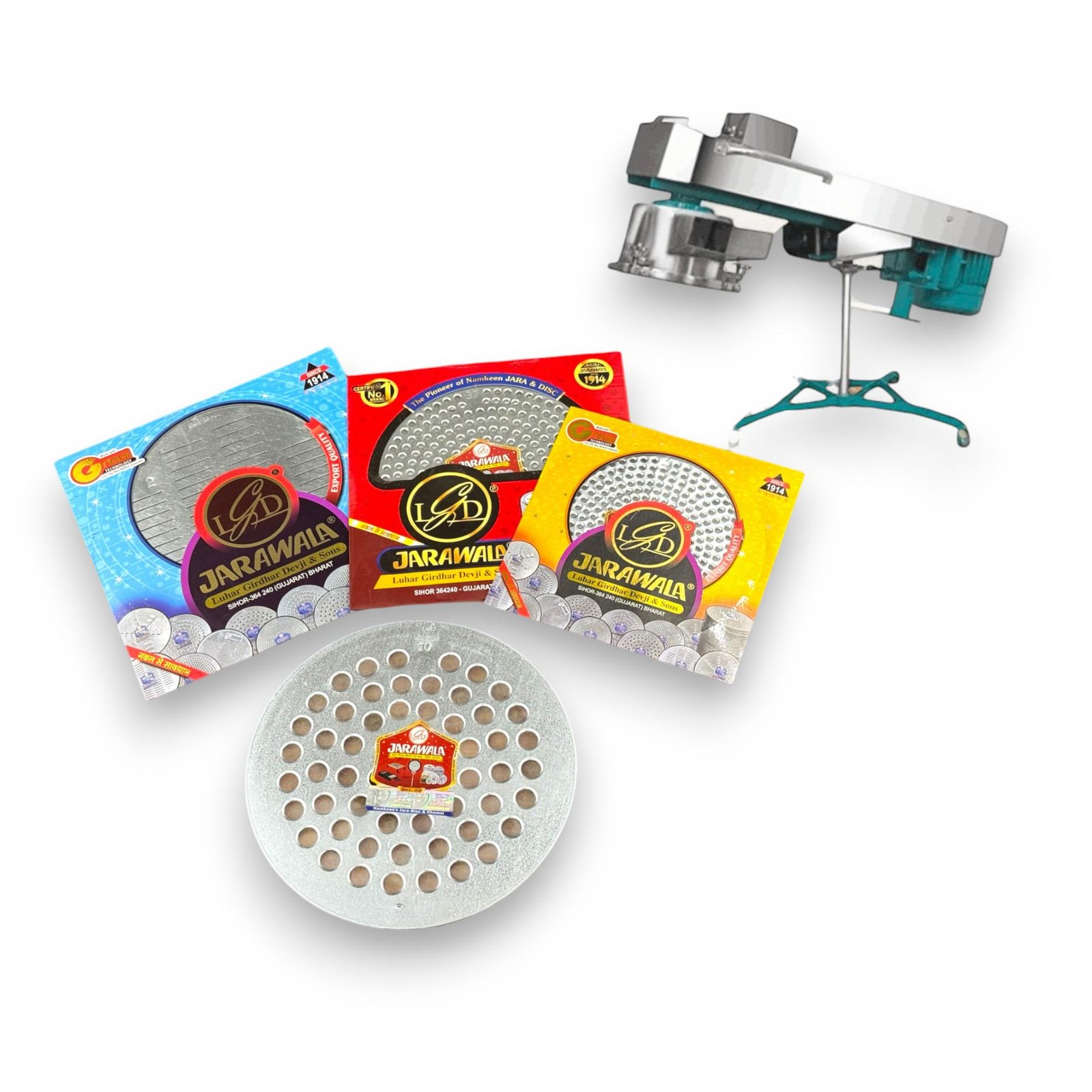
Regardless of whether you choose SS 304 or High-Tensile Brass, all Jarawala extruder dies are cut on high-power fiber laser systems and mirror-finished. We ensure that hole throats feature engineered entrance funnels that eliminate dough stagnation zones and prevent thermal discoloration. Also check our OD & Bore Sizing Chart.

4. Frequently Asked Questions (FAQ)

Can I wash brass extruder dies in caustic cleaning solutions?
No. Caustic soda (sodium hydroxide) and strong acid descalers will corrode and pit brass surfaces, destroying hole tolerances. For brass dies, clean with warm water and neutral food-grade degreasers. If your plant relies on automated caustic CIP washes, switch to Jarawala SS 304 extruder plates.
Does Jarawala manufacture custom brass dies for imported machines?
Yes. We manufacture custom brass and stainless steel dies for all domestic and imported snack extruders, matching exact metric or imperial outer diameters, bolt circles, keyways, and thickness requirements.
What is the delivery turnaround time for custom dies?
Standard sizes (5″ to 8″ OD) ship within 24 to 48 hours from our Sihor, Gujarat manufacturing facility (Pan-India transit 1–6 days; Gujarat ₹70/kg, Rest of India ₹100/kg). Custom blueprint CNC dies typically ship within 3 to 5 business days across India.

Consult with Jarawala Extrusion Tooling Specialists

Get factory-direct guidance on metallurgy, sizing, and pricing for your commercial farsan plant. Direct dispatch from Sihor, Gujarat.


Get Factory-Direct Pricing & Sizing Quote (+91 94277 77746)

Leave a Reply

Your email address will not be published. Required fields are marked *